When I first started learning about digital security, I often thought Cyber Security and Information Security were exactly the same. Many people use these terms interchangeably because both are related to protecting valuable information. However, after spending more time understanding these concepts, I realized that they are different in many important ways.
Knowing the difference between Cyber Security and Information Security is useful whether you are a student, business owner, IT professional, or simply someone who uses the internet every day. Understanding these concepts helps us make better decisions about protecting our personal and professional information.
In this article, I will explain the difference between Cyber Security and Information Security in simple language. My goal is to make these concepts easy to understand so that anyone, even a beginner, can clearly see how they are connected and where they differ.
What Is Cyber Security
Cyber Security refers to the practice of protecting computers, networks, servers, mobile devices, software, and online data from digital attacks. It mainly focuses on defending systems that are connected to the internet or digital networks.
Today, almost every organization depends on technology. Businesses store customer records online, governments maintain digital databases, and individuals use smartphones for banking, shopping, and communication. Because of this, cyber criminals constantly look for ways to steal information or disrupt services.
Cyber Security is designed to stop these attacks before they cause damage.
Some common Cyber Security measures include using antivirus software, firewalls, encryption, multi factor authentication, secure passwords, intrusion detection systems, and regular software updates.
The primary purpose of Cyber Security is to prevent hackers from gaining unauthorized access to digital systems.
What Is Information Security
Information Security is a much broader concept. It focuses on protecting all types of information, whether that information is stored digitally or physically.
Many people think information only exists on computers, but that is not true. Information can also be stored in paper files, printed documents, handwritten notes, filing cabinets, or even spoken conversations.
Information Security protects every form of valuable information regardless of where it exists.
Its main objective is to maintain confidentiality, integrity, and availability of information.
Confidentiality means only authorized people can access information.
Integrity means information remains accurate and cannot be changed without permission.
Availability means authorized users can access information whenever they need it.
These three principles are often considered the foundation of Information Security.
The Main Difference
The easiest way I explain the difference is this.
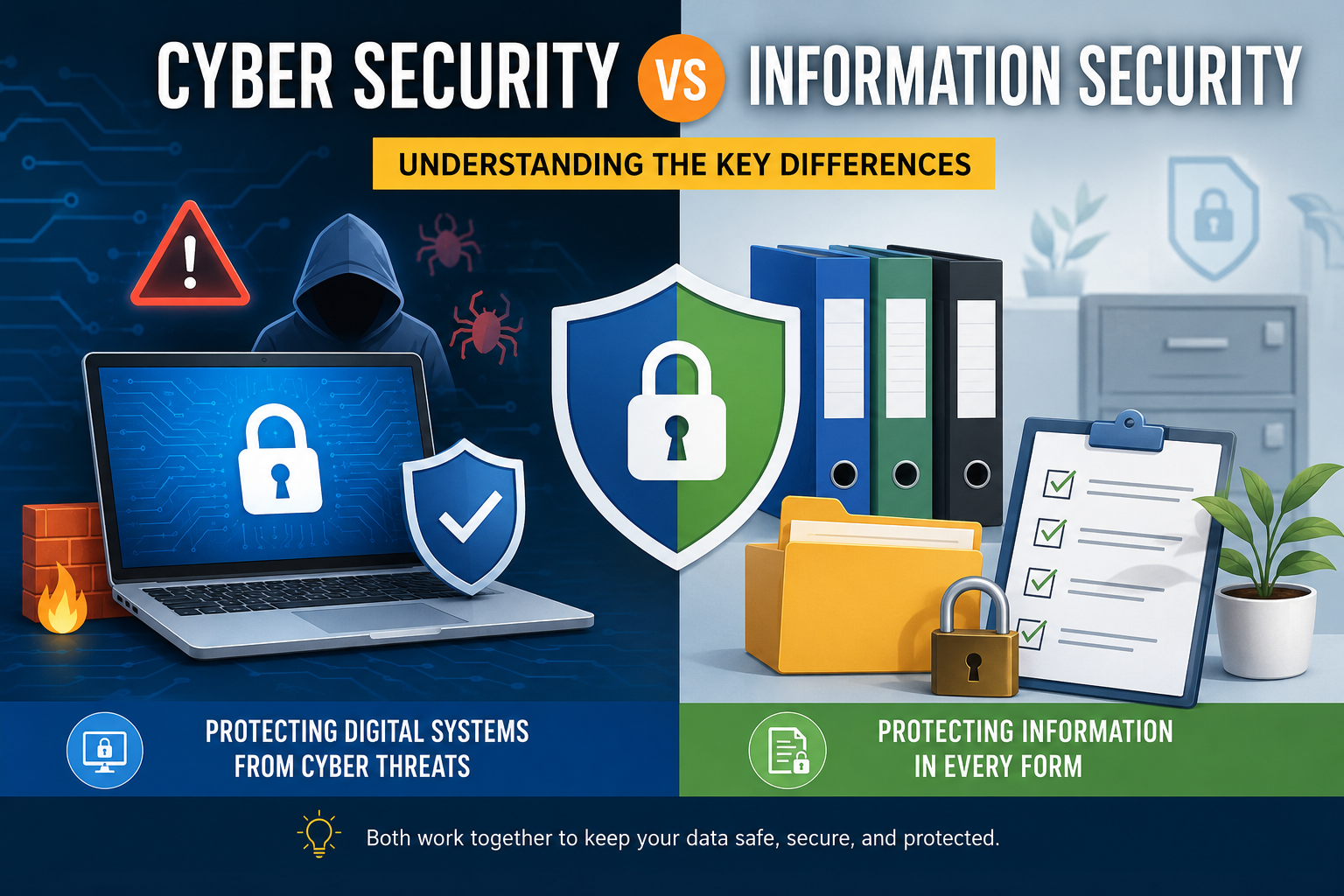
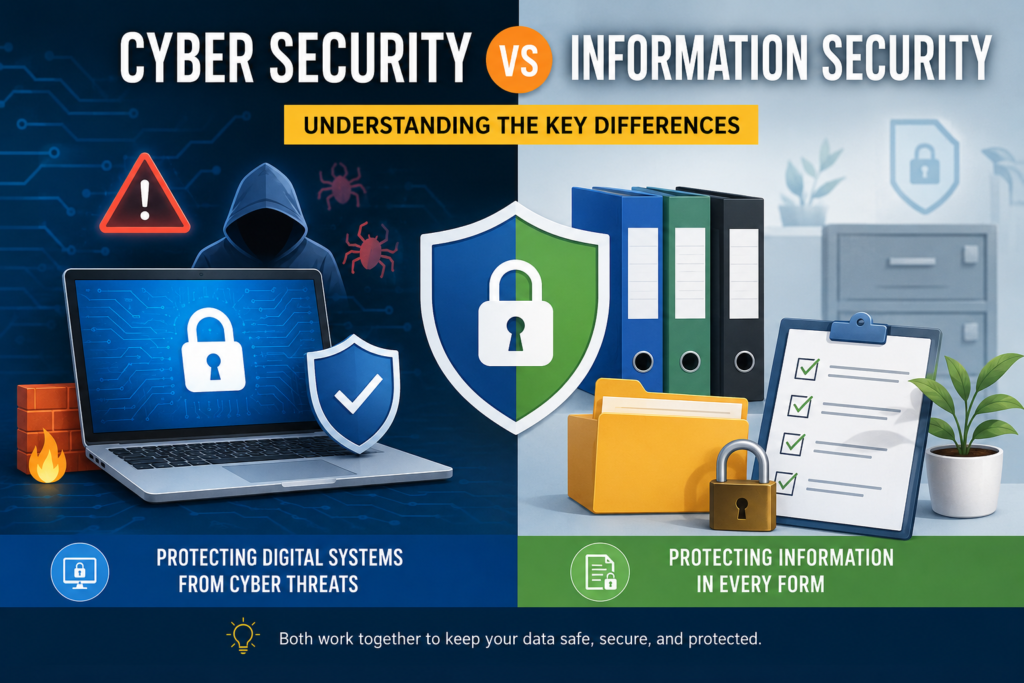
Cyber Security protects digital systems from online threats.
Information Security protects information in every form.
This means Cyber Security is actually a part of Information Security.
For example, imagine a company stores customer records.
The digital database must be protected from hackers. This is Cyber Security.
The printed copies stored in locked cabinets also need protection. This is Information Security.
Both are important because sensitive information exists in different forms.
Scope of Cyber Security
Cyber Security mainly deals with digital environments.
Its responsibilities include protecting websites, cloud services, company networks, email systems, online databases, applications, mobile devices, and internet connected hardware.
Cyber Security professionals monitor networks, detect suspicious activities, respond to cyber attacks, remove malware, and improve overall system security.
Their work constantly evolves because hackers continuously develop new attack methods.
Scope of Information Security
Information Security covers everything related to protecting information.
This includes digital security, physical security, document management, employee awareness, access control, company policies, disaster recovery, and legal compliance.
For example, an employee leaving confidential documents on a public desk is an Information Security issue even though no computer was involved.
Similarly, sharing confidential business information with unauthorized people is also an Information Security problem.
This wider scope makes Information Security an essential part of every organization.
Threats Faced by Cyber Security
Cyber Security professionals face many different digital threats every day.
Some of the most common threats include malware, ransomware, phishing emails, spyware, viruses, password attacks, data breaches, denial of service attacks, identity theft, and network intrusions.
Hackers constantly search for vulnerabilities that allow them to steal information or interrupt business operations.
Because technology changes rapidly, Cyber Security requires continuous monitoring and regular updates.
Organizations cannot simply install antivirus software once and assume they are protected forever.
Threats Faced by Information Security
Information Security deals with both digital and physical risks.
Examples include unauthorized document access, stolen laptops, lost mobile phones, employee mistakes, insider threats, physical theft, natural disasters, accidental deletion of files, and poor security policies.
Sometimes information is exposed because of simple human errors rather than sophisticated hacking.
An employee might accidentally send confidential information to the wrong person.
Someone may leave important documents in a public place.
These situations are Information Security concerns even though hackers were never involved.
Goals of Cyber Security
The primary goal of Cyber Security is to protect digital systems from cyber attacks.
Professionals working in this field focus on preventing unauthorized access, detecting threats quickly, responding to incidents, recovering compromised systems, and reducing future risks.
Cyber Security aims to create a safe digital environment where users can confidently use online services without fear of losing sensitive information.
Goals of Information Security
Information Security has a broader mission.
Its goal is to protect valuable information regardless of its format.
This involves developing security policies, training employees, controlling physical access, managing sensitive documents, securing digital data, and ensuring information remains accurate and available whenever needed.
Information Security looks at the complete lifecycle of information from creation to storage, sharing, and secure disposal.
Key Differences Between Cyber Security and Information Security
Although both fields aim to protect valuable assets, they do so in different ways. Here are the major differences that I always keep in mind.
| Cyber Security | Information Security |
|---|---|
| Protects digital systems and online assets | Protects all types of information |
| Focuses mainly on cyber threats | Focuses on both digital and physical threats |
| Deals with hackers, malware, ransomware, and phishing | Deals with data protection, physical security, policies, and employee awareness |
| Covers computers, networks, cloud systems, and applications | Covers paper documents, digital files, conversations, and business records |
| Is a subset of Information Security | Is the broader field that includes Cyber Security |
| Mainly protects internet connected systems | Protects information wherever it exists |
When I compare both fields, I always remember one simple rule. Every Cyber Security activity supports Information Security, but Information Security includes many responsibilities that go beyond computers and the internet.
Real World Example
Let me explain this with a simple example.
Imagine a hospital stores patient records.
The hospital has an online database that doctors use every day. If hackers try to break into the system, Cyber Security tools such as firewalls, encryption, and intrusion detection systems work to stop the attack.
Now imagine the same hospital also keeps printed medical files inside locked cabinets. Those files must be protected from theft, unauthorized access, or accidental damage. Employees should only access files related to their work, and visitors should never enter restricted areas.
This physical protection is part of Information Security.
In this example, both Cyber Security and Information Security work together to keep patient information safe.
Why Businesses Need Both
Many organizations mistakenly believe that installing antivirus software is enough to secure their information. In my opinion, this is one of the biggest misconceptions.
A company may have excellent Cyber Security, but if employees leave confidential documents on their desks, share passwords, or discuss private information in public places, valuable information can still be exposed.
Similarly, a business may have strict policies for handling paper documents, but if its website gets hacked because of outdated software, customer data can still be stolen.
That is why successful organizations combine Cyber Security with Information Security to build a complete protection strategy.
Skills Required in Cyber Security
People who work in Cyber Security usually develop strong technical skills.
Some of the most important skills include understanding computer networks, operating systems, ethical hacking, penetration testing, cloud security, malware analysis, digital forensics, encryption, programming, and incident response.
Cyber Security professionals also need problem solving abilities because attackers constantly develop new techniques.
Learning never stops in this field because technology changes every year.
Skills Required in Information Security
Information Security professionals require both technical knowledge and management skills.
They should understand risk management, security policies, compliance requirements, data classification, access control, disaster recovery planning, business continuity, auditing, and employee security awareness.
Communication skills are also important because Information Security often involves training employees and creating company wide security policies.
The focus is not only on technology but also on people and business processes.
Career Opportunities
Both Cyber Security and Information Security offer excellent career opportunities.
Cyber Security careers include Security Analyst, Penetration Tester, Ethical Hacker, Security Engineer, Network Security Engineer, Cloud Security Specialist, Digital Forensics Expert, and Security Operations Center Analyst.
Information Security careers include Information Security Manager, Risk Analyst, Compliance Officer, Security Consultant, Information Security Auditor, Data Protection Officer, and Governance Risk and Compliance Specialist.
As businesses continue to depend on technology, the demand for skilled professionals in both fields continues to grow.
Which One Is Better
People often ask which field is better. From my perspective, there is no simple answer because both have different purposes.
If you enjoy working with computers, solving technical problems, analyzing malware, and defending networks against hackers, Cyber Security may be the better choice.
If you enjoy creating policies, managing risks, protecting business information, and improving organizational security, Information Security may be more suitable.
Neither field is more important than the other. They complement each other and together create a strong security framework.
Common Misunderstandings
One misunderstanding I often notice is that people think Cyber Security and Information Security are identical.
Another misconception is that Information Security only applies to large companies. In reality, every individual and every organization handles information that should be protected.
Some people also believe Cyber Security only concerns hackers. While defending against hackers is a major responsibility, Cyber Security also includes protecting systems from accidental damage, software vulnerabilities, and many other digital risks.
Understanding these differences helps people appreciate why both fields are necessary.
Best Practices for Better Security
Whether you are protecting personal information or managing a business, I believe everyone should follow a few basic security practices.
Use strong and unique passwords for every account.
Enable multi factor authentication whenever possible.
Keep software and operating systems updated.
Back up important data regularly.
Avoid clicking suspicious links or downloading unknown files.
Store sensitive paper documents in secure locations.
Limit access to confidential information.
Train employees about security awareness.
Review security policies regularly.
Dispose of sensitive documents safely.
These simple habits significantly reduce both cyber risks and information related risks.
Conclusion
After learning about both fields, I realized that Cyber Security and Information Security are closely connected but not identical.
Cyber Security focuses on protecting digital systems, networks, applications, and online data from cyber threats. Information Security has a much broader scope because it protects information in every form, including digital files, printed documents, and even verbal communication.
I believe every modern organization needs both. Cyber Security keeps hackers away from digital systems, while Information Security ensures that valuable information remains confidential, accurate, and available regardless of where it is stored.
As technology continues to evolve, the importance of these two fields will only increase. By understanding the difference between Cyber Security and Information Security, we can make smarter decisions, reduce risks, and better protect the information that matters most.